
Why 'pretzel' should be 'bretzel'
The RobWords Newsletter

Welcome to another RobWords Newsletter. Coming up:
ETYMOLOGY ROULETTE – pretzel
VOCABULARY EXPANDER – vagitus
Word Origins to Snack On
And much more.
Time for a hearty helping of word facts and language fun.

PRETZEL
Its origins untied
What do these two things have in common?
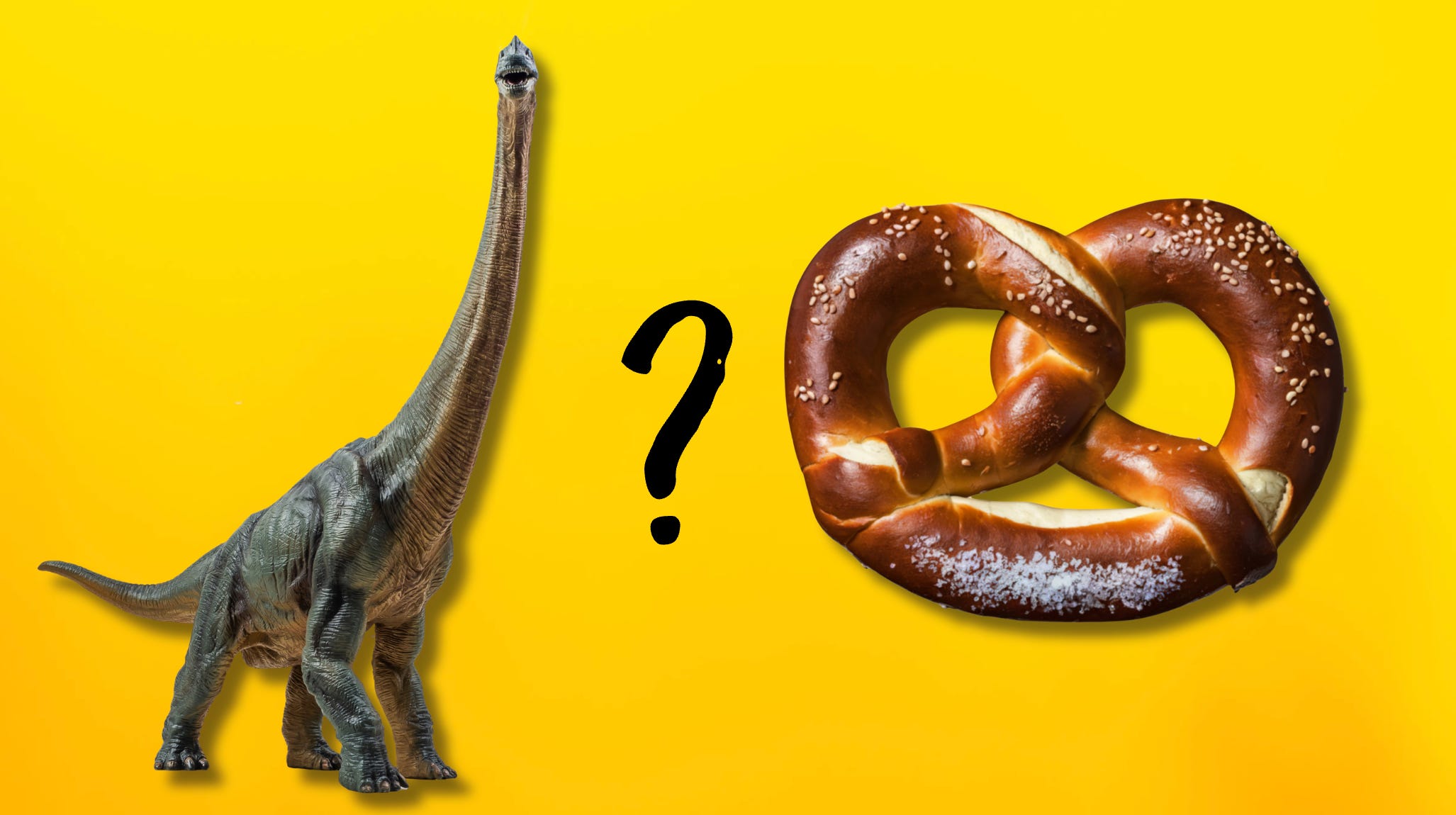
Read on and I’ll explain.
The word pretzel was adopted into English in 19th century New York, along with a whole host of words for European delicacies shared among the city’s “huddled masses”.
The word we’ve adopted is a variant on the more standard German name for the salty snack: Brezel.
In the description below (of, to my mind, the perfect evening) you can also see the B in Blutwurst turning into a P as well.
1856
‘What is the German diet?’ ‘Sourkrout, pretzels, plutworst, and lager beer.’
– The Spirit of the Age
This plosive swap is worth mentioning because Brezel is a better reflection of the word’s etymology.
In Old High German the baked knot was called a brezitella, which is thought to be a borrowing of the Latin word brachiatellus. I say “thought to be” because no one has ever found the word brachiatellus written down. However, it seems likely it existed.
This translates as “little thing with arms” – apparently because of the pretzel’s resemblance to folded arms. The brachia- bit comes from Greek brakhion for “arm”.
That same element also appears in the name of the dinosaur pictured up top. The brachiosaurus or “arm lizard” was so named because of its sensationally long forelimbs.
So what links a long-necked dinosaur and a pretzel? Their arms.

Introducing RobWords Live
I’m immensely excited to announce I’m doing my first live show.
Join me for an evening of etymology and general word-nerdery at London’s marvellous Bloomsbury Theatre on Saturday 11th April.

I promise it’s going to be tremendous fun.

VAGITUS
The cry of a newborn baby.
Your life probably began with a vagitus. It’s the primal wail, formed from your first gulps of air, that heralded your entry into the world.
The word is from the Latin verb vāgīre, meaning “to cry out.”*
Here’s a 17th-century example of its metaphorical usage.
a1651
“Thou hast not yet the strength of a well grown Christian; well, but is there the vagitus of an Infant?"
– An Elegant and Learned Discourse of the Light of Nature
Vagitus has also been used to describe any screams from the operating theatre. However, its meaning of a nascent noise from newborn lips is rather more elegant, don’t you think?
USE IT TODAY!
*Before you ask: no, it is not related to vagina, which (unfortunately) means “sheath”.

The Dog Mystery
The English words nobody can explain
In my latest YouTube video, I investigate the extraordinary mysteries behind some of our most common words, including dog, big and bird.
Give it a watch below.

Can you guess the correct definition of the word below?
FERETORY
Proud
A shrine
Pertaining to polecats
A storehouse for heavy metals
I’ll give the answer at the end of the newsletter.

Etymology to Snack On
If the origin of pretzel has whet your appetite, here are some more tasty word tales:
BAGEL – From Yiddish beygel, which is in turn a borrowing of Austrian German Beugel. This referred to either the familiar bread ring or a crescent-shaped pastry (more on that in a sec). Ultimately it means “little bracelet”.
CROISSANT – It’s French for “crescent”. While we consider it a Gallic delicacy, the French attribute the croissant to the Austrians (see BAGEL) and refer to such pastries as Viennoiserie, or “stuff from Vienna”.
COOKIE – Cookie has been borrowed into English twice: first in Scotland and then in New Amsterdam (now New York). It’s from Dutch koekje meaning “little cake”.
NACHOS – Nacho is a pet form of Ignacio, the snack having been invented by Mexican chef Ignacio Anaya in the 1940s.
MARSHMALLOW – Marshmallow is the name of the plant from which the sweet treats were originally made. It’s a mallow commonly found in a marsh or other wasteland. Gross.
HAMBURGER – Means “thing from Hamburg”. Nothing to do with ham.
CHURROS – A lot of online sources claim the churro derives its name from the Iberian churra sheep, because the fried batons resemble its twisted horns. However, this fun but flawed explanation (churros aren’t twisted) doesn’t tend to appear in more scholarly etymologies. They generally suggest churro comes from an old Romance word meaning greasy or coarse: either a direct reference to the snack itself or a nasty dig at the Spaniards who ate them.

FERETORY
A shrine
A feretory is a shrine that holds saintly relics. It’s ultimately from the Greek pherein meaning “bear” or “carry”. Well done if you knew it.