
Karaoke is a bit English
The RobWords Newsletter

Welcome to another RobWords Newsletter. Coming up:
ETYMOLOGY ROULETTE – karaoke
VOCABULARY EXPANDER – wamblecropped
Trademark death
And more.
Strike up the band! It’s time for a symphony of word facts and language fun.

KARAOKE
An etymology sing-along
Karaoke is made up of two Japanese components: kara meaning “empty” and oke, which is short for okesutura, meaning “orchestra”.
In fact, okesutura is just the word orchestra adapted to fit Japanese speech patterns. So karaoke is half English.
The man most widely credited with inventing the karaoke machine is Daisuke Inoue, who was awarded the 2004 Ig Nobel Peace Prize for “providing an entirely new way for people to learn to tolerate each other”. His doodad combining an amplifier, a microphone, a car stereo, and a coin slot first appeared in clubs in Kobe (of beef fame) in 1971.
In an interview in 2005, he described how the craze his machine helped create came to be called karaoke. The term makes reference to an incident back in 1956:
“A famous theatrical troupe in Osaka, the Takarazuka Kageki, performed every night to a live orchestra. One day, the orchestra went on strike. The parent company, Hankyu, apparently wouldn’t give in to their demands and couldn’t find a replacement orchestra in time for the scheduled performances. Hankyu called up an electronics company, Matsuda Electronics, and had them bring in a machine that could play orchestra music on a large scale. It is said that someone from Matsuda looked into the pit and said, “The music is playing but the orchestra pit is empty!”
– Daisuke Inoue in Topic Magazine (2005)
I did a bit of extra research into this. The company involved was Matsushita Electric – later Panasonic – and their in-house newspaper covered the incident.
Here’s the image and headline it carried.
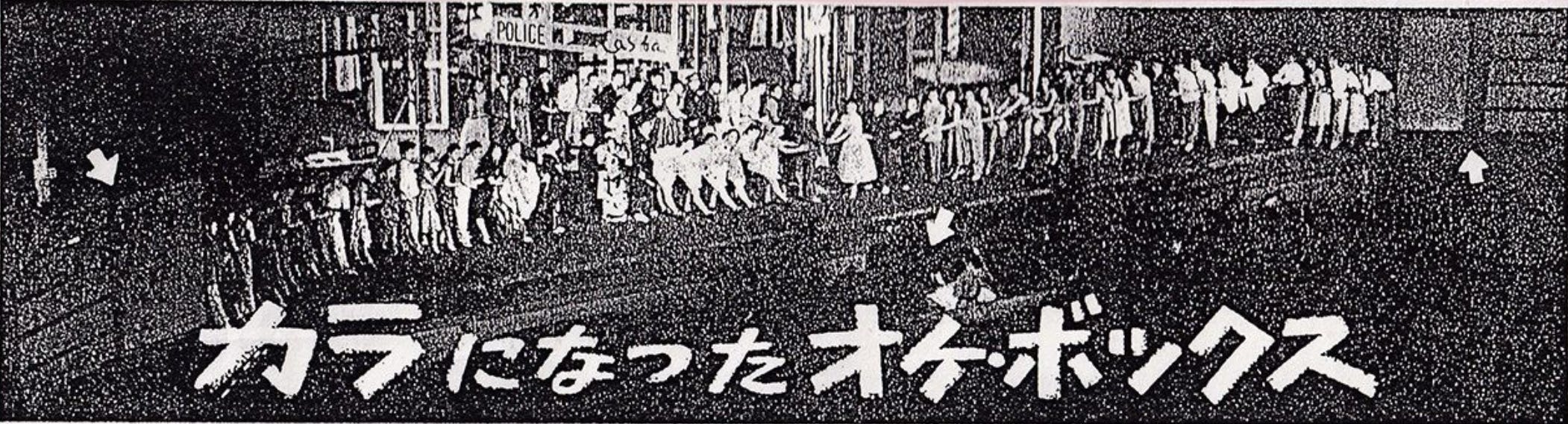
The three arrows point to the speakers pumping out the orchestral music, and the headline reads, “The orchestra pit became empty”.
The original karaoke.

WAMBLECROPPED
WOM-bul-crop’d
Meaning: Feeling sick
To be wamblecropped (or wamble-cropt or womble-cropped) is to be overcome with nausea.
The Oxford English Dictionary carries examples of the term’s use from the 1500s, 1600s, 1700s, and 1800s. This surprised me, because usually such whimsical old terms only have a couple of citations.
1798
“I feel a good deal womblecropped about dropping her acquaintance.”
– The Massachusetts Spy
1844
“I got back to the sloop and turned in awfully womble–cropped.”
– High Life in New York
Believe it or not, the womble- bit is distantly related to the word vomit. And the -cropped implies you’ve been “brought down” by the feeling.
I, for one, shall be adding this word to my emetic arsenal – If only to avoid the whole nauseous vs. nauseated dichotomy.
USE IT TODAY!

We’ve added an extra show to RobWords Live!
Demand for tickets to my show in London has been so high that we’ve added an extra performance. There are now two opportunities to join me for some word facts and language fun on 11th April. Hope you can make it.


Can you pick the correct definition of the word below?
OSCITANCY
Drowsiness
Seasickness
Stubbornness
Moving like a pendulum
I’ll pop the solution at the end of the newsletter.

Watch or listen to the latest episode of Words Unravelled below. This week, we’re investigating the origins of espionage words.

TRADEMARK DEATH
Escalator, Velcro, Sellotape and Band-Aid all started off as trademarked names.
You might think that nothing could be more flattering to a brand than to become synonymous with the product they create. When google became something you could do on any search engine, it only served to underline Google’s dominance in its field.
However, such “genericization” can sometimes result in a brand losing its trademark and, therefore, any control over the name’s use. When this happens, it’s called “trademark death” or, even more ominously, “genericide”.
In the 2000s, the photocopier manufacturer Xerox fought an active, public-facing campaign against the genericization of its name. It ran magazine ads featuring other victims of trademark death, urging readers not to use xerox as a verb.
Slogans included:
“If you use ‘Xerox’ the way you use ‘zipper,’ our trademark could be left wide open.”
and
“When you use ‘Xerox’ the way you use ‘aspirin’, we get a headache”
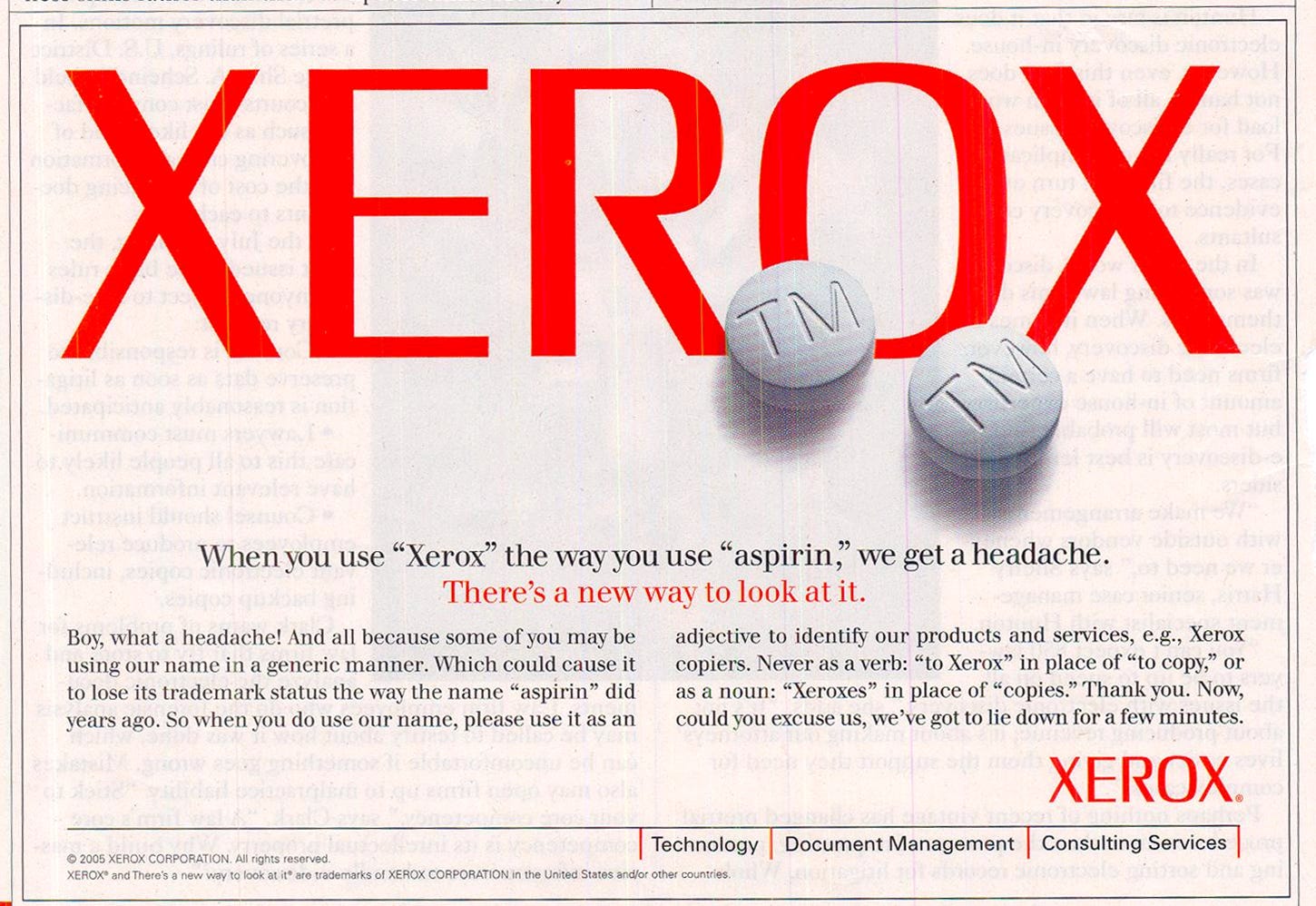
Xerox won insofar that it still holds its trademark, but xerox has nevertheless become a general word meaning “photocopy” in some parts of the world.
Around the globe you’ll find the brand names kleenex, hoover, tipp-ex, jeep, bic and tannoy being used with apparent unawareness that they were once – or still are – trademarks.

OSCITANCY
Drowsiness
It’s the sort of inattentive tiredness you can really see. The word traces back to Latin ōscitārī meaning “to yawn”.