Welcome to another RobWords Newsletter. Coming up:
ETYMOLOGY ROULETTE – random
VOCABULARY EXPANDER – hiraeth
Words we don’t have
And much more.
I hope you enjoy this haphazard assortment of word facts and language fun.
RANDOM
A random word origin
The image you should probably have in your head when you hear the word random is someone charging around flailing their arms about (although the arms-flail is optional).
The term represents a borrowing of the Middle French randon, which meant “haste” and is probably derived from the verb randir meaning “to run”.
Tracing the word further back than that is tricky, but a leading theory is that it ultimately came from the Franks. Some etymologists reckon the Germanic-speaking people who lived in what is now France had the word *rant meaning “running”.
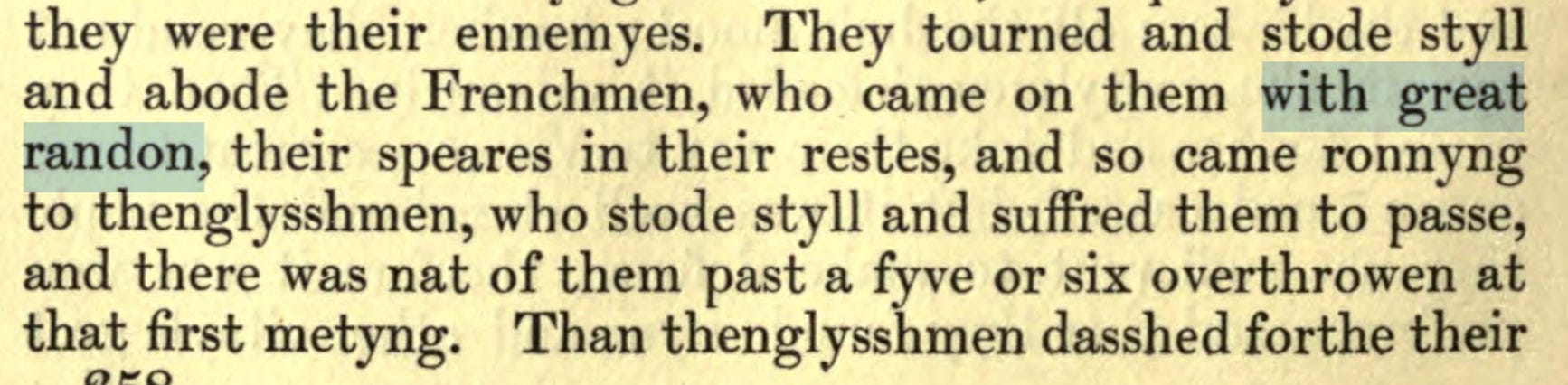
When randon first enters English, it refers to acting with speed or impetuosity, often in the phrase “with great randon”:
1523
“The Frenchmen […] came on them with great randon, their spears in their rests, and so came running to the Englishmen”
– The Cronycle of Syr John Froissart
The idea of fast-paced chaos eventually gives way to the meaning “having no definite aim or purpose”, which it can still hold today. Much later, we get the concept of statistical randomness, which apportions equal chance to all outcomes (I bet I’ve oversimplified that).
The switch from the -n of randon for the -m of random is puzzling, but not without precedent. The same nasal noise swap happened with ranson to give us ransom.
HIRAETH
An intense yearning for something lost
Pronounced hee-RIGH-th, this Welsh word entered English because we needed it.
Hiraeth refers to an intense longing for somewhere, someone, or something. It tends to be used in reference to a Welsh person missing their beloved Wales.
1989
“I could not begin to put into words the hiraeth that the Welsh feel for the mountains and valleys of their homeland.”
– Sydney Morning Herald
While “homesick” might do an adequate job of covering the sentiment in the quotation above, we have no term so versatile as the word hiraeth. Its usage extends far beyond pining for the green, green grass of home.
2017
“His ‘empty chair’..resonates with homes all over Wales where there were other empty chairs and hiraeth for the young men who never returned from the trenches.”
– Cardiff’s Western Mail
The sumptuously Celtic term does a lovely job of expressing the sense of incompleteness you feel when a beloved person, place or object is far away from you.
USE IT TODAY
Could tensions “escalate” before the invention of the escalator?
In the latest episode of our podcast Words Unravelled, Jess Zafarris and I discuss how inventions get named and the words that spring from technical innovations.
If you liked my recent piece about “trademark death”, this is also the episode for you. Give it a watch – or a listen – below.
Can you pick the correct definition of the word below?
FLYPE
A roller on a typewriter
To send a message via an airtight tube
To roll up your stockings before putting them on
Public excitement following the invention of the aeroplane
I’ll put the solution at the bottom of the newsletter.
Words We Don’t Have
The Welsh have kindly enriched English by giving us the word hiraeth, however there are many more terms in languages around the world that we would do well to steal. Here are a few notable ones.
Tsundoku – Japanese: I, for one, need this word. It describes the phenomenon of acquiring books only to allow them to pile up in your home, unread.
Torschlusspanik– German: Literally “gate-closure panic”, the term originates in medieval walled cities, where there was a genuine danger of being shut out of the town overnight. Nowadays, however, it is used to describe the anxiety that you are running out of time to achieve life goals.
Rebonjour– French: If you bump into someone twice in quick succession, what do you say the second time? “Hello again”? Rubbish. The French have a single word for the renewed greeting: literally “re-good day”.
Kalsarikännit – Finnish: Sometimes translated as “pantsdrunk”, kalsarikännit describes drinking booze at home in your underwear with no intention of going out. Homer Simpson claimed to be an aficionado of the practice in an episode where he met a Finn.
Lagom– Swedish: “Just the right amount.” Not merely sufficient: the ideal quantity. The Goldilocks Zone.
Gluggaveður – Icelandic: It literally translates as “window-weather” but means the kind of weather that looks great from indoors, but horrible when you get out in it. Imagine a bright day that actually has a dreadful, cutting wind. If you’ve been to Iceland, you’ll know why they have this word.
FLYPE
To roll up your stockings before putting them on
This snippet of Scottish dialect originally meant to fold back a piece of fabric, like when you turn up your sleeves. More recently, flype has come to denote specifically the gathering up of your socks, stockings or tights to be able to slip your foot in more easily.
Thanks for reading. This post is public so feel free to share it.