

It's neither ZED nor ZEE
The RobWords Newsletter

It’s another RobWords Newsletter. Coming up:
ETYMOLOGY ROULETTE – barbecue
VOCABULARY EXPANDER – izzard
You Speak Taíno
And more.
Time to fire up the grill and cook up some smoky word facts and language fun.

BARBECUE
Food for buccaneers
Have you ever considered how odd the abbreviation BBQ is? The first syllable does not sound like “bee”, and the final one does not begin with a Q. Also: since when do we abbreviate single words in this way, anyway? Nevertheless… it just works.
The elements that make up the word – bar, be, and cue – taste so familiar on the tongue. However, barbecue is from a language entirely unrelated to our own. Its origins lie in the tongue of the Taíno people, who inhabited the West Indies before the Europeans turned up (and all but wiped them out).
It was the Spanish who first borrowed the word barbacòa, used on Hispaniola to refer to a “wooden framework”. Such a lattice was sometimes used for roasting meat.
The earliest known written use of barbecue in English, according to the folk at Oxford, is in the 1661 Jamaica viewed with all its ports[blah blah unreasonably long old-fashioned title] by one Captain Hickeringill. Unfortunately, it appears embedded in a thoroughly vile poem about the supposed behaviours of the native people of the region.
Honestly – the full stanza would ruin, if not your entire day, at the very least your breakfast. So here’s just enough of it to prove that the reference exists:

The clumsy-looking use of “Eat” instead of “eaten” is to allow for a rhyme with “Meat”.
It is a further delectable fact that barbecue has a smoky cousin in buccaneer. The 17th-century French boucanier meant a woodsman who prepared meat on a wooden frame called a boucan. This word is thought to have come from Tupi, also indigenous to the Americas.
These woodsmen were swashbuckling sorts, who would occasionally take to piracy for an income boost. In turn, boucanier – whence buccaneer – came to refer to a pirate, too.
IZZARD
Meaning: Z
Let’s put an end to the whole “Zed or Zee” debacle by bringing back this old name for the letter Z.
Need proof that our alphabet once ended in such charismatic fashion? Here it is, laid bare by dictionary boffin Samuel Johnson in A Grammar of the English Tongue:
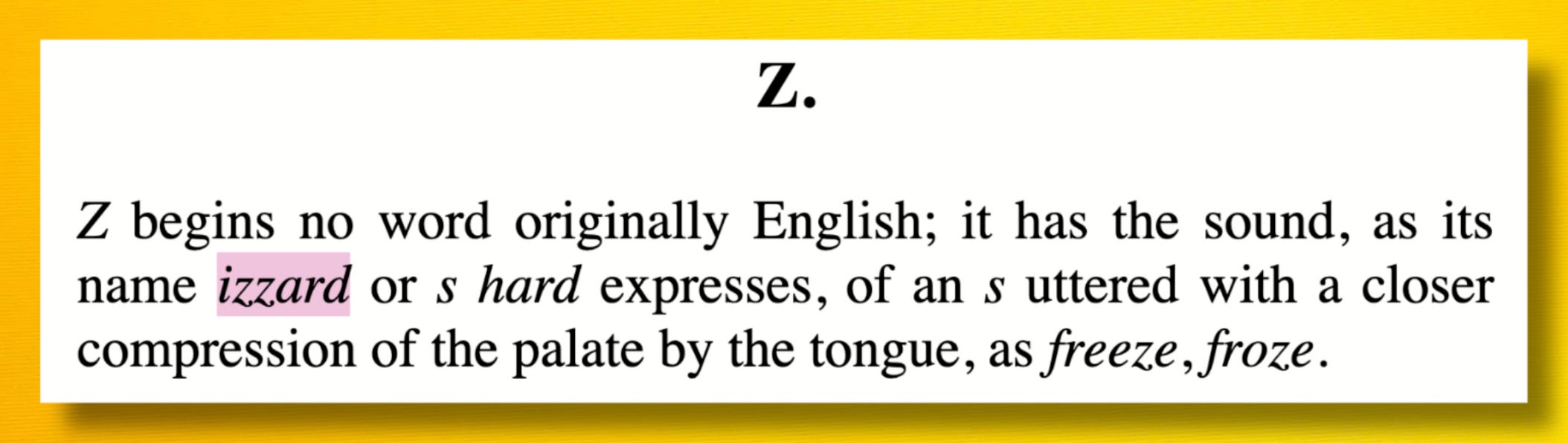
Johnson even provides us with an etymology for the word, which may or may not be the true origin. Etymologists point to dialect variants such as izzet and uzzit, which seem unlikely to have come from “s hard”.
Whatever the origin of izzard, do share the word with every Eddie or Suzy you know. Perhaps we can build up enough momentum to reinstate it and close a transatlantic rift in the process.
USE IT TODAY

Some “untranslatable” words are fake.
I’ve been investigating the internet’s favourite foreign words.
Hygge, saudade, lagom, mbuki-mvuki, mamihlapinatapai... Do these “untranslatable” words really mean what the online listicles say they mean? Are they even real?
Some of them are not. To find out which ones, watch below.

TICKETS TO MY EDINBURGH SHOW!
I’m doing ten nights of my wordy nerdy live show at this year’s Edinburgh Fringe.
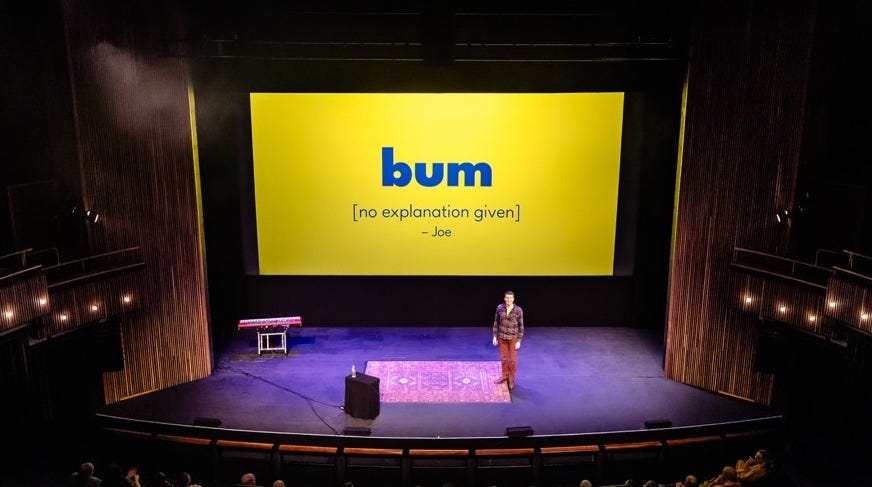
Come see me at 8.10pm from the 6th to the 16th of August.

Can you spot the correct definition of the word below?
MAGNALITY
Generosity
Attractiveness
A wonderful thing
Likelihood of eruption
I’ll put the solution at the end of the newsletter.

You Speak Taíno
They gave us more words than you think.
We have the Taíno people who inhabited the Caribbean to thank for barbecue. What’s more, their language gave us many more of the earliest words to make the trip from the Americas to Europe.
In a lot of cases, the original word has been lost. The Spanish declared the Taíno people “extinct” after a census in 1565, which showed none of them living on Hispaniola (now Haiti and Dominican Republic). This is often referred to as a “paper extinction” because the bureaucratic approach quite likely missed the Taíno who were still on the island.
Nevertheless, much of the culture – including the language – was lost by the 1800s. However, its legacy endures in the words we borrowed. Here are just a few of them:
CANOE – The Spanish are thought to have picked up their word canoa from Taíno. The evidence lies in the existence of similar words in other Arawak languages.
MAIZE – From Taíno mahiz or mahis.
JAMAICA – The name for the island is believed to have been borrowed from the Taíno. Their word, in turn, is thought to have meant something like “large place with water”.
SAVANNAH – For me, and probably other Europeans, this word evokes thoughts of Africa. However, its origins lie in the Caribbean with the Taíno zavana. In early English usage, it described an open plain of long grass, primarily in the Americas.
BARRACUDA – This underwater hunter perhaps gets its name from the Taíno baracutey, used to describe a solitary person or animal.
PAPAYA – Papaya, and therefore also pawpaw, is thought to come from the Taíno name for the tree that bears the fruit.

MAGNALITY
A wonderful thing
From the Latin magnalia, meaning “great things” or “miracles”. From the 17th century: “Fill thy Spirit […] with the mysteries of Faith, the magnalities of Religion.”
My wife is from Hong Kong. She has always pronounced Z as 'e-zett' which is pretty close to iizard, if not identical. Perhaps a very old tradition survived in colonial Hong Kong!
This is one of the few times I got a definition correct. When I looked at Magnality, I thought of Banality as a possible antonym. I don't know for sure if it is, but it was my reasoning for selecting “A wonderful thing” as the definition.
Thank you for an interesting read as always.