

Grammar is glamour.
The RobWords Newsletter

Welcome to another RobWords Newsletter. Coming up:
ETYMOLOGY ROULETTE – grammar
VOCABULARY EXPANDER – raphanidosis
BIG NEWS!
And more.
Time for some glamorous word facts and language fun.

GRAMMAR
A kind of magic
Grammar and glamour are variants of the same word.
The sounds usually associated with r and l are produced in similar ways in the mouth, so the letters often get swapped around. Inconsistent spelling conventions take care of the rest of the differences.
Both grammar and glamour come from Middle French gramaire, a word used to describe books about the rules of language, and the rules themselves. Whence our modern meaning of grammar.
However, gramaire could also mean the acquisition of knowledge in general. The grammar books were mostly guides to Latin, and that language was associated with the wisdom of the learned.
That wisdom also involved knowledge of subjects beyond the earthly, such as astrology and magic. In Scottish English in particular, the word therefore took on a mystical meaning.
In 18th-century Scotland, to “cast the glamour over” someone was to put them under a spell.
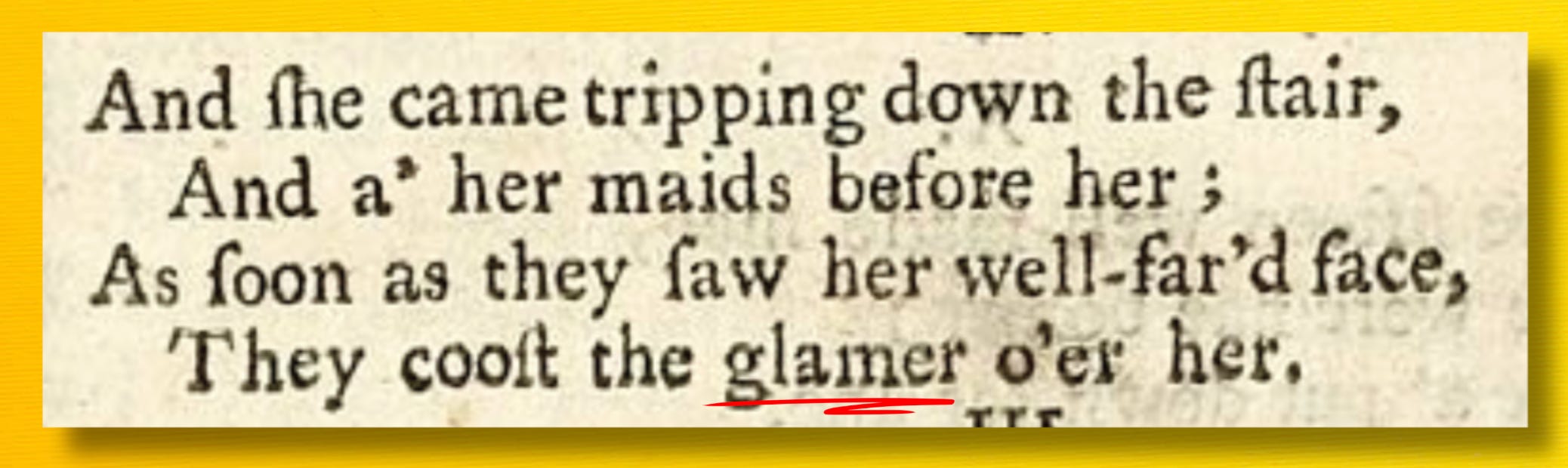
This is an excellent opportunity to point out that the two meanings of spell implied by casting a spell and spelling a word are distantly related. They share an ancient Germanic root meaning “to read out”.
Anyway, the magical meaning of glamour shifted to refer to that which was “enchanting” or “charming”. That is why we describe beguiling clothing as glamorous.

I’m taking my show to this year’s Edinburgh Fringe!
This is not something I ever expected to happen.
Following the success of my wordy nerdy live shows in London earlier this year, I will now be performing 10 nights at this year’s Edinburgh Fringe.

If you fancy spending an hour revolutionising the English language with me, I’ll be on at 8.10pm at the Assembly George Square Studios from 6th to 16th August.
Click below for tickets.

RHAPHANIDOSIS
RAF-uh-nid-OH-sis
Meaning: An uncomfortable punishment involving a radish
If you ever find yourself in ancient Greece, DO NOT get caught cheating.
Rhaphanidosis (literally getting “radished”) was a punishment for adultery: a means for a man to exact revenge against whoever had slept with his wife.
The cuckolded husband was permitted to stuff a radish up his love rival’s bottom. Ouch.
It gets a mention in one of Aristophanes’ plays:
“But what if he should suffer rhaphanidosis through obeying you, and be depillated with hot ashes? What argument will he be able to state, to prove that he is not a blackguard?”
– Aristophanes, The Clouds (423 BCE)
“Depillated with hot ashes” refers to another humiliation ritual, involving plucking out an offender’s hairs. It’s best not to think too hard about which ones.
USE IT TODAY!

Can you identify the correct definition from the options below?
LUCUBRATE
Fortunate
To work at night
To write part of the Bible
To treat in order to reduce friction
I’ll reveal the answer at the end of the newsletter.

How did The Beatles get their name?
Why is it called "Rock and Roll"? And which bands took their names from literature?
Jess Zafarris and I answer all manner of musical etymological questions in the latest episode of Words Unravelled. Watch or listen below.

Grammatical Etymologies
Here are the literal meanings of some words from English class.
NOUN – Nouns are simply the words we use to name the things around us, be they physical or abstract. From Latin nōmen via French nom/non “name”.
PRONOUN – This does not mean “in favour of names”. Rather, the pro- implies substitution. A pronoun is a word that replaces a noun in a sentence.
VERB – From Latin verbum, our word for “doing word” just means “word”. Indeed, it shares an ancient root with word.
ADJECTIVE – The -ject is the same as we find in reject and eject, or the jet in jettison, all of which imply throwing. Adjective means “thrown on/at”, because an adjective is an attachment to a noun.
ADVERB – A “to-the-word”. An adverb is added to a verb to describe how it is being performed.
PREPOSITION – The way we pronounce preposition obscures its otherwise very intuitive meaning. If we pronounced it pre-position, it’d be clearer that we’re referring to those little words like in, on, at, under, and through, which are positioned before a noun (e.g. on the bed, in the newsletter).
TENSE – Tense represents a borrowing of the Old French tens, which was just a variant of modern French temps, meaning “time”. It is not related to feeling tense, which is from Latin tendĕre “to stretch”.
SYNTAX – Syntax refers to the order in which you place words, phrases and clauses. It’s from Greek syntaxis meaning “arrangement”.

LUCUBRATE
To work at night
From Latin lūcubrāre (and ultimately lux meaning “light”), it originally referred to working by candlelight. It has also come to mean “laborious study”, so a lucubration can be a learned piece of writing.
Some languages have their prepositions after the noun - I wondered what they are called so I then discovered postpositions and circumpositions (after and around the noun). Even in English there are occasional use of these like 'from now on'
Congrats on the Dùn Èideann gig! I'm no' Scottish laddie, but I love the Gàidhlig - it's a really great language (I finished the duolingo course which currently only goes up to a 60 rating). I have been to Scotland once for a few days (stayed in Edinburg and GlenCoe). I expect interesting RobWords from you after your trip!